


.jpg)
🔨🛠️Built to Last: Finding the Grit to Keep Going When You’re Worn Out


The Word of God often challenges us with language that goes beyond a surface-level reading, demanding discernment and a willingness to engage in deeper critical thinking. Scripture is frequently layered with metaphors and symbolic imagery that require us to slow down and look past the literal to find the divine intent. A primary example of this is found in Isaiah 40:31:
"But those who hope (wait) on the LORD will renew their strength; they will soar on wings like eagles; they will run and not grow weary, they will walk and not faint."
While this is a familiar passage, a closer, more deliberate examination of the phrase "soar on wings like eagles" reveals a powerful promise regarding how God sustains His people.
The Babylonian Backdrop: A People Spent

To understand the power of Isaiah 40:31, we must first look at its birth. It was originally addressed to the Israelites during their 70-year Babylonian Exile. Stripped of their home, their temple, and their dignity, they felt forgotten by God—convinced that the Babylonian gods were more powerful than their own. In this "dark night of the soul," the exiles were physically and spiritually spent, living as refugees in a land of foreign tongues and customs. While Babylon worshipped hero-gods of physical might, Isaiah argued that even the strongest youth would faint under life’s pressure. Only the "Everlasting God" could provide a path out of the "Babylon" of brokenness.
The Ruach: The Symbolism of Wind and Spirit
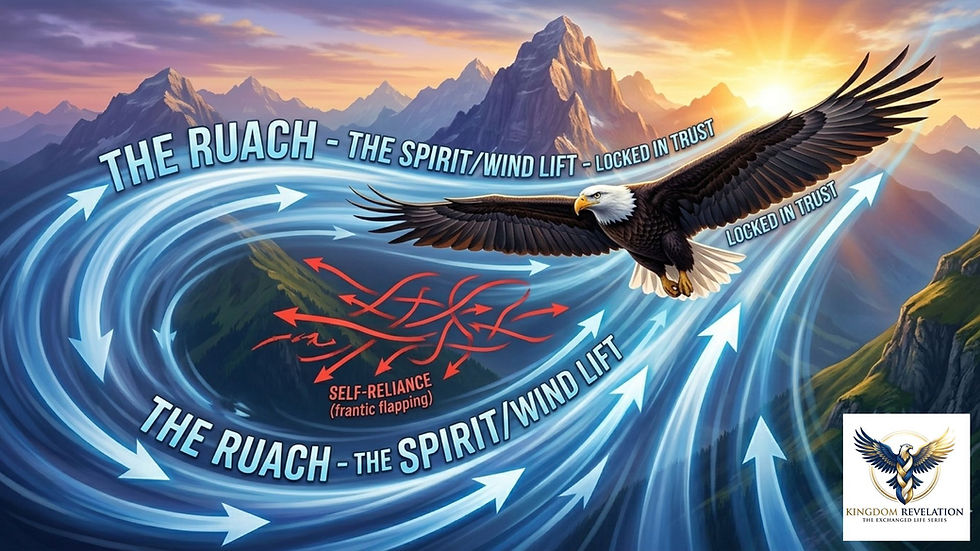
The metaphor of soaring relies on a Hebrew wordplay: "Ruach." This single word means "spirit," "wind," and "breath" simultaneously. Just as an eagle cannot soar without the physical wind (ruach), a believer cannot "mount up" without the Holy Spirit (Ruach).
Like the wind, the Holy Spirit is invisible and uncontrollable, yet known by His effects—transforming hearts and providing supernatural lift to weary souls. In this divine aerodynamics, the "wings" represent our faith, and the "wind thermal" is the Holy Spirit. To soar, we must spread our wings to catch the lift God is already providing, rather than trying to fly through frantic human effort.
Why "Like" Eagles?
Unlike smaller birds designed for constant flapping, eagles possess broad wings shaped like an airfoil to generate natural lift. Because eagles have large bodies but relatively small hearts, constant flapping quickly exhausts them. Instead, they wait for "thermals"—rising columns of warm air—and lock their wings to be carried upward. This is the "Exchanged Life" in action: you aren't just fixing your tired strength; you are handing over your weakness to God and receiving His infinite power in return (Chalaf). It is the act of taking off the heavy, worn-out garments of exhaustion and putting on His supernatural power.
The Condition: The Braided Life
The promise of flight is tethered to a condition: "Those who wait (Qavah) on the Lord." This Hebrew term implies an active, tension-filled anticipation, like a rope being pulled tight. Qavah shares a root with the word for a cord or rope, carrying the imagery of several strands being braided together. When we "wait," we are essentially braiding our lives into God's so that His strength becomes our strength.
Like an eagle perched for days waiting for a thermal, this "waiting" is an active trust in God’s timing. You meet this condition by admitting you have no strength left and positioning yourself like a servant, ready for instruction. When you "wait" (Qavah) on the Lord, you are not merely standing still; you are braiding your fragile, snapping thread into His unbreakable, eternal strand—exchanging your exhaustion for His infinite power. The Word of God does not promise to simply "recharge" you like a battery; it promises a radical transfer of nature. You aren’t merely becoming a "better version" of yourself; you are being structurally integrated into the Almighty.

This "braiding" (Qavah) is not a passive seat in a waiting room; it is an active, high-tension binding of your heart to His. Just as a rope is useless without the twisting pressure that locks the fibers together, the "wait" is forged in the tension of trusting what you cannot see and refusing to cut the cord when the world tells you to run. It is trusting that His promises and His character will move on your behalf. It is acknowledging that the Word of God is the first and final authority over your circumstances. It is standing firm—even if you must stand alone—when the world, your family, your friends, or your coworkers tell you otherwise.
You are shifting from a solitary, vulnerable strand to an unbreakable "threefold cord" (Ecclesiastes 4:12) that cannot be snapped by the storms of your job, your spouse, your government, or your family.
"Though one may be overpowered by another, two can withstand him. And a threefold cord is not quickly broken."
You meet the condition to soar not by "flapping" harder with your own weary arms but by entwining your will so tightly with His that His sovereignty becomes your lift. You don't just endure the weight; you inherit the strength of the One who carries the world. The mechanical exhaustion of "flapping" in self-reliance ends only when you lock your wings in faith, allowing the Ruach—the Holy Spirit—to transform your struggle into a supernatural ascent.
The Three Tiers of Divine Endurance: To soar is to trade ground-level panic for a high, heavenly perspective that looks down on the crisis from the safety of God’s sovereignty. To run is to access a supernatural, marathon stamina for those high-intensity seasons where the workload is heavy but the spirit remains unshakeable. To walk is to master the most difficult discipline of all—the steady, daily persistence to keep moving forward even when life feels like a slow, heavy, and unremarkable grind.
Instead of sprinting blindly into the chaos of your circumstances, the Word of God calls you to a radical halt. We do not find our way by running faster into the dark, but by stopping to anchor our trust in the immutable promises of God and the unwavering character of the Creator (Numbers 23:19).
“God is not a man, that He should lie, Nor a son of man, that He should repent. Has He said, and will He not do? Or has He spoken, and will He not make it good?
To "wait" is to live in the fear of the Lord, which is the beginning of all true wisdom and the only guard against the frantic pride of self-effort (Proverbs 9:10).
“The fear of the LORD is the beginning of wisdom, And the knowledge of the Holy One is understanding.
This is the discipline of the "perch"—refusing to move until you have listened for His instruction and allowed the peace of God, which transcends all human understanding, to stand guard over your heart and mind (Philippians 4:7).
"And the peace of God, which surpasses all understanding, will guard your hearts and minds through Christ Jesus."
The exiles didn’t claw their way out of Babylon through human revolt or frantic "flapping"; they were carried out by the sovereign hand of the Living God. When the decree of release finally fell, these weary refugees were transformed into a soaring people, marching out of their "dark night" with the very treasures once stolen from them. Their homecoming proves that those who braid their hope into the character of God will always outlast the systems designed to crush them. The fall of Babylon is the ultimate evidence that while empires expire, the strength you receive through the divine exchange is eternal.

Do not move until the peace of God descends to still your frantic flapping; only then can you spread your wings to catch the Ruach. As you wait, your life becomes so tightly entwined with His that you no longer merely survive the storm—you are propelled by it into your God-given purpose. Learn to anchor yourself in the middle of the chaos. Search for the peace that guides you, and only when that peace falls, move in that direction.
Stop flapping. Start soaring.
Share the Word: Feel free to pass this along to anyone in the "grind."
To receive more insights on the Exchanged Life, join our mailing list!
Steward of Kingdom Revelation:
© 2026 Amanda Allen. All Rights Reserved. Scripture taken from the Holy Bible, [Version NKJV/NIV].
Prayer & Connection: Click here 🙏🏼🛜


.jpg)


Comments