


.jpg)
When God’s Love Calls Out Our Lies: Finding the Mercy Hidden in Our Greatest Failures.

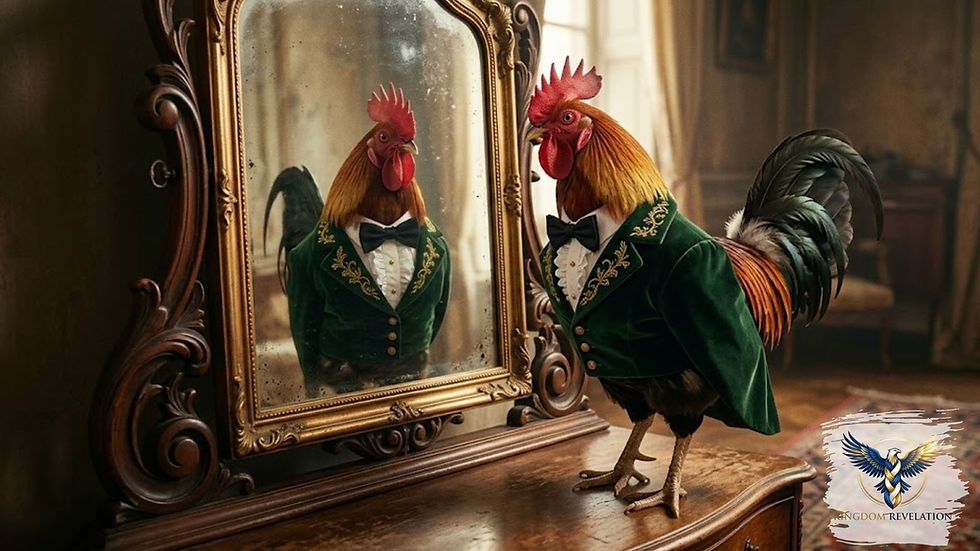
God has no problem calling us out. He frequently shatters our self-deception by forcing a collision between the human narrative—that carefully crafted story we tell ourselves about our own strength, goodness, and loyalty—and His absolute, unvarnished truth. This spiritual threshold is often reached when we are at our most confident, unaware that our pride has built a wall between who we think we are and who we actually are. To break through that wall, God uses a specific kind of wake-up call: the "rooster moment."
The Bridge: From Ego to Awakening
We all live with a version of ourselves that is slightly more heroic than reality. This ego acts as a buffer, protecting us from our flaws but also insulating us from our need for a Savior. However, God’s grace is too relentless to leave us in a lie. He allows a "rooster" to crow in our lives—not to shame us, but to rescue us. This moment is not merely a failure; it is a mercy. It is the jarring, painful, yet necessary sound that wakes us from the sleep of self-deception, forcing us to drop the mask and finally see God’s truth.
The Warning Ignored
The depth of Peter’s self-deception is revealed in his interaction with Jesus just before the arrest. Jesus explicitly warned Peter of his coming failure, but Peter’s ego refused to believe it. He thought he knew his own heart better than the Creator of it:
“Jesus said to him, ‘Truly, I tell you, this very night, before the rooster crows, you will deny me three times.’ Peter said to him, ‘Even if I must die with you, I will not deny you!’ And all the disciples said the same.” > — Matthew 26:34-35 (ESV)
The Scriptural Source: The Collision
Hours later, the confidence Peter displayed at the dinner table evaporated in the cold air of the courtyard. After Jesus was arrested and led away to the high priest's house, Peter followed at a distance. Three times he was confronted by the crowd, and three times the fear of man overcame his boasted resilience.
The "rooster moment" happened the instant Peter's reality collided with Jesus' prophecy:
“And immediately, while he was still speaking, the rooster crowed. And the Lord turned and looked at Peter. And Peter remembered the saying of the Lord, how he had said to him, ‘Before the rooster crows today, you will deny me three times.’ And he went out and wept bitterly.” > — Luke 22:60-62 (ESV)
The Reality Check
In that singular moment, the rooster’s cry acted as a cosmic gavel. It didn't just signal the dawn; it signaled the death of Peter’s ego. The "look" from Jesus wasn't one of "I told you so," but a mirror reflecting Peter’s true state back to him. It was the exact moment Peter saw past his own lies and finally encountered God’s truth: that Jesus already knew everything, and Peter’s only hope was not his own strength, but the grace and mercy of the One he had just denied.
The "rooster moment" is not merely a failure; it is a mercy. It is the jarring, painful, yet necessary sound that wakes us from the sleep of self-deception.
The Anatomy of a "Rooster Moment"
A "rooster moment" usually shares three distinct characteristics: the illusion of self-sufficiency, the trigger, and the turning point. Before the "crow", there is always a belief that we are the "exception." We think we are too moral to fail, too smart to be deceived, or too strong to fall. The "crowing" is an external event—a crisis, a conversation, a realization—that we cannot ignore. It is the truth cutting through our defenses. It is the moment we stop defending our character and start weeping for our state. It is the transition from ego (which demands we be right) to humility (which admits we need grace).
Other "Rooster Moments" in Scripture
While Peter’s experience is the archetype, many other biblical figures had their own "rooster" moments where their pride was shattered by God’s truth:
1. King David and Nathan (The Mirror)
David had committed adultery and murder, yet his ego allowed him to keep ruling as if he were righteous. The prophet Nathan arrived and told a parable about a rich man stealing a poor man's lamb. David’s pride flared in righteous indignation—until Nathan held up the mirror: "You are the man!" (2 Samuel 12:7). That was David's rooster moment; the facade dropped, and he wrote Psalm 51 in repentance.
2. Saul of Tarsus (The Blindness)
Saul was the pinnacle of religious pride. He truly believed he was doing God a favor by persecuting Christians. On the road to Damascus, the light from heaven acted as his "rooster." It stripped away his perceived righteousness and forced him to ask the only question that matters: "Who are you, Lord?" (Acts 9:5). His physical blindness represented the spiritual blindness his ego had caused.
3. The Prodigal Son (The Pig Pen)
The younger son left home with the ego-driven belief that he knew better than his father and that he didn't need the family structure. The "rooster moment" happened when he was starving in the pig pen. The text says, "He came to himself" (Luke 15:17). That moment of realization—that his way had led to ruin and his father’s way was actually the path of life—was his turning point.

The Ultimate Truth
The reason the "rooster moment" is so vital is that grace cannot enter where there is no room. If we are full of our own perceived goodness and pride, we have no space for the transformative power of the Gospel. These moments are intended to prove that Jesus is the truth. They strip away the "self-made" version of us, which is a fragile, unstable thing, and replace it with the "God-remade" version, which is built on the solid ground of humility and dependence.
When you look back on your own life, can you identify a specific "rooster moment"—a time when a difficult realization actually paved the way for you to find a deeper, more humble truth about yourself or your faith? Pride isn't just a character flaw; it is a spiritual trajectory that leads toward a cliff. When we operate out of that "ego-centered" version of ourselves—the one that sounds good and feels strong—we are actually walking in the footsteps of the first being to ever experience a "rooster moment."
If we refuse to listen to the gentle whispers of the Spirit, God’s faithfulness drives Him to hold up a mirror. It is a terrifying mercy, because if He left us in our pride, we would follow the same path as the "Son of the Morning", Lucifer.
The Fall of Lucifer
The greatest lesson of unchecked pride is found in the account of Satan’s fall. It serves as the ultimate warning that pride is the only thing that can turn an archangel into a devil. Scripture describes a being of immense beauty, wisdom, and authority who began to believe his own "heroic narrative." He moved from serving the Truth to trying to be the Truth.
"How you are fallen from heaven, O Day Star, son of Dawn! ... You said in your heart, 'I will ascend to heaven; above the stars of God I will set my throne on high... I will make myself like the Most High.'" — Isaiah 14:12-14 (ESV)
Pride Comes Before the Fall
The "I will" of the ego is what caused the destruction. Lucifer’s fall was the result of a heart that became so intoxicated by its own reflection that it forgot who created the mirror. Pride precedes destruction. This is an immutable law of the spiritual world:
"Pride goes before destruction, and a haughty spirit before a fall." > — Proverbs 16:18 (ESV)
When we live in that ego-centered state, we are essentially building a skyscraper on a foundation of sand. God, in His love, will often pull the building down while we are still on the ground floor, rather than letting us reach the top only to have the entire structure collapse on our souls.
The Mercy of the Mirror
God holds up the mirror because He loves the person, but He hates the pride. He knows that pride is a terminal disease; it isolates us from God and others, making us unteachable and unreachable.
Satan’s fall was a judgment because he refused to repent in his pride.
Peter’s fall was a mercy because the rooster’s crow led him to "weep bitterly"—the sound of a heart breaking open so that grace could finally get in.
God is faithful to call us out because He would rather see us weep in the truth than smile in a lie. The "rooster moment" is the sound of God refusing to let us settle for a fake version of ourselves when He has a redeemed, humble, and truly powerful version waiting on the other side of our repentance.
Do you think we often mistake God's "calling us out" as punishment, when in reality, it's actually the highest form of protection? Think about it.
Blessings.....
Share the Word: Feel free to pass this "Rooster Moment" message along to anyone you know who is caught in the "grind" of maintaining a false image. It might be the exact wake-up call they need.
To receive more insights on finding truth through the "Mercy of the Mirror," join our mailing list!
Steward of Kingdom Revelation: © 2026 Amanda Allen. All Rights Reserved. Scripture taken from the Holy Bible, [Version NKJV/NIV].
Prayer & Connection: Click here 🙏🏼🛜


.jpg)


Comments